
My family was falsely accused of racism by a powerful school in a small town. Our business was destroyed. We won our case. But the school is refusing to pay.
Published Sep 1 2022
From Commonsense
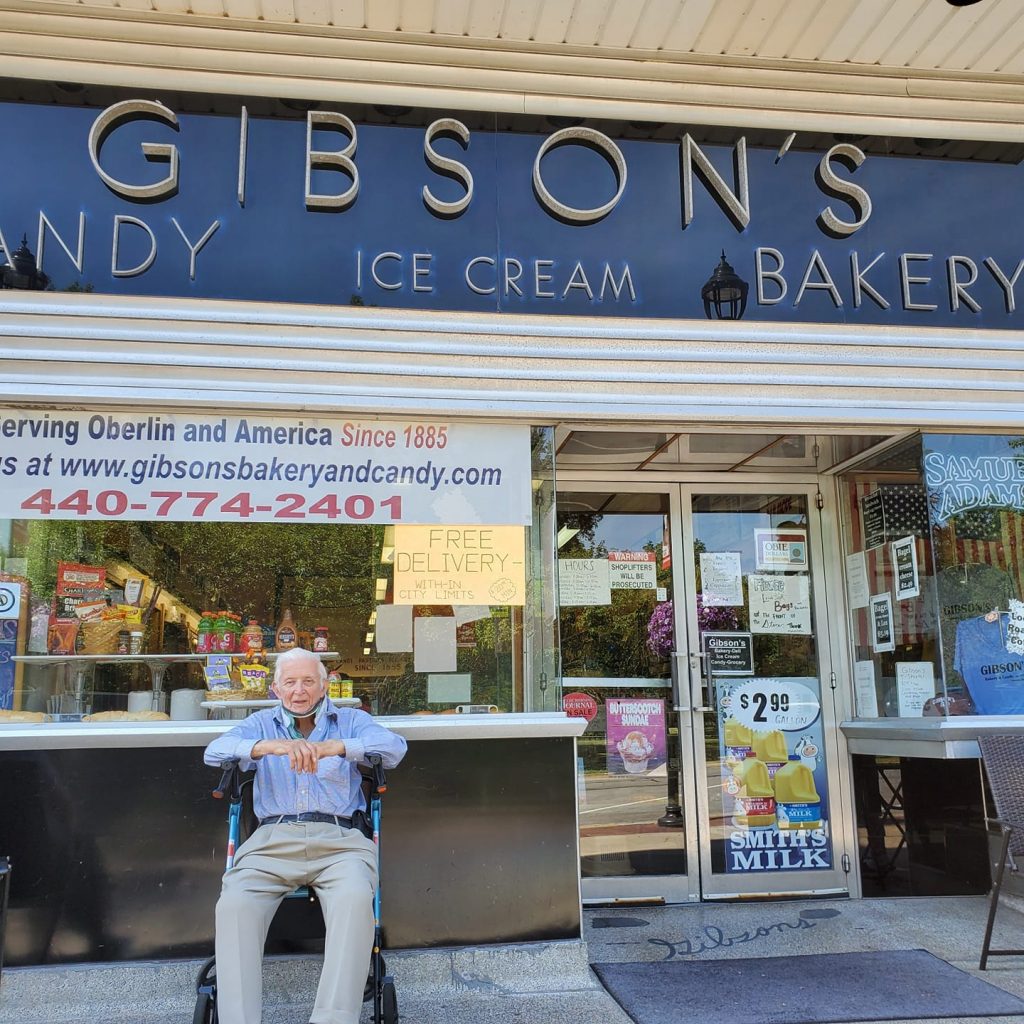
Allyn Sr. in front of his family’s bakery. (via Facebook)
OBERLIN, OHIO — On the night of November, 8, 2016, Donald Trump was elected president and the country was forever changed. But for my family, it was the following night—November 9, 2016—that our world was turned upside down and has never been set right.
Late that night, my husband, David, came home from work and told me that there had been a shoplifting incident at our bakery, Gibson’s. We’ve been in business for 137 years, so we’ve had our fair share of shoplifters, including earlier that very week. That particular night, a student from the local college, Oberlin, had tried to steal two bottles of wine, and use a fake ID to buy a third. Our son, Allyn, had pursued him across the street. Two more students got involved. Allyn was beaten up pretty badly, and the three students were arrested.
David was afraid the incident would blow up, since the students claimed to the police that my son had assaulted them—not the other way around. He told me he was scared it would hurt our business since the students who were arrested were black and bystanders were already claiming that Allyn had racially profiled them.
But none of us had any idea of what was about to happen.
The next day, I opened the store around 7 a.m., and soon I got a sense of what David feared. Over the next few hours, hundreds of students began to gather in front of the store. They chanted “Boycott Gibson’s” and held signs that said we were white supremacists. They called us racists on their bullhorns. The students weren’t alone. College administrators were there, too, handing out flyers and addressing the crowd on a bullhorn. The protesters also distributed flyers that said we had a “LONG ACCOUNT of RACIAL PROFILING and DISCRIMINATION.”
They blocked the door and screamed at customers who elbowed their way through to the counter. A few came in to record videos on their phones of our customers. This went on all day. Late that night, when I went to collect the tables and chairs that we keep outside for customers, I was surrounded by screaming protestors. I was frightened—and all I could think was that I needed to keep our employees safe.
The next day, the protests continued, though the police were mostly able to keep them across the street. But the damage to our relationship with the school and its students had already been done.
Before November 9, our relationship to the school had been wonderful. We delivered pizza dough, bagels, and cookies to the dining halls every day. We did pie and ice cream socials for parents’ weekend, and pastry trays for parties. I worked as a nurse at a local hospital until 2002, but if there were a large order, I’d often help David deliver the trays of baked goods to campus.
A week after the incident, the school canceled all of our standing orders. That was just the beginning of my family’s nightmare.
The school put out a statement that implied that this wasn’t an isolated incident. The school’s student senate passed a resolution urging the school to cut ties with us, which was posted in a display case at the student center. Our business from the students themselves and administrators—we have a small grocery store and sell beer and wine in addition to our pastries and candies—dried up completely. And the students kept showing up to protest.
David met with the President of the school, along with other administrators, to try to get Oberlin to retract its baseless claims that we were racist, and to quell the small group of students who, in their passion, had gotten us so wrong. But Oberlin would not even consider issuing a statement, and allowed the public to believe that we were in fact “racist,” even after the students pled guilty.
Instead, the school proposed a deal where, in the future, if a student were caught shoplifting, we’d call the dean instead of the police. My husband and his dad believe firmly that everyone should be treated equally, so they refused. Eventually, in 2017, we felt that we had no choice other than filing a lawsuit against Oberlin (for libel, among other things) because David’s 89-year-old father, who had dedicated his life to the business, did not want to die being falsely branded a racist.
By the time the trial started, things were falling apart. We couldn’t make payroll, so we had to let go of half of our employees and cut our operating hours way back. My father-in-law, who made bagel deliveries to the college into his eighties, loved to sit outside the store all day and talk to whomever went by. He was a fixture in the community. Since word about the business with the college had spread, he’d sit outside for hours and hours, but no one would talk to him. It broke his heart, and mine. Calling us racists wasn’t just wrong, it was deeply painful to our core.
During the months leading up to the trial, my husband receded from my view. We didn’t really talk like we used to, and we took to co-existing in our home. He was so worried about the trial, and he didn’t want to worry me. I had a lot on my plate, too. My mother, who was suffering from dementia, was living with us. One of our bakers, his wife (an Oberlin graduate), and their two-year-old had moved into our living room because his wife was dying of ALS. After my father-in-law got badly injured, he moved in with us, too.
To add onto everything else, six months before the trial began, my husband David was diagnosed with advanced pancreatic cancer. He was still working from seven in the morning to eleven at night, but the cancer treatments were brutal. Once the trial started, David decided to pause the treatments so he could be as strong as possible in court. It was important to him that the jury not find out that he was sick. He wanted the case to be decided on the basis of the facts alone.
When the jury found in our favor—they ruled that we were owed $44 million in damages (which was later reduced to $31 million)—relief washed over me. I thought we’d finally be able to move past this and get back to work.
But after the verdict was handed down, David and I left Oberlin to seek treatment for his cancer at bigger hospitals in the South and in New York. We found out that the cancer had spread during the trial, and that we had no recourse. Before he died in 2019, David asked me to keep the store going. “Just keep the doors open, no matter what,” he said. He gave his life for the store, and I promised him that I would do everything I could to honor his final wish.
I still haven’t seen a penny from the school. In 2019, Oberlin appealed to have the jury verdict overturned. Ohio’s Ninth District Court of Appeals rejected Oberlin’s claims and upheld the jury’s verdict. But in May of 2022, Oberlin appealed again to the Ohio Supreme Court to try to avoid the jury’s decision. Thankfully, earlier this week, the Ohio Supreme Court denied Oberlin’s appeal and ruled that the school must pay us $36 million. But even with this most recent ruling, the college, which has about a billion dollars’ worth of assets at its disposal, still refuses to pay.
We hoped that, with time, the kids who started all this would graduate, and that new students would come in and that the whole drama would fade. But I’m told that freshmen are still told to boycott us. Parents who come in tell me that their kids have been brainwashed to hate us.
I was with my father-in-law, Allyn Sr., when he died several months ago, at the age of 93. We laughed a lot during his last days. He loved his stories, and he was telling them until the end. Most of them revolved around the bakery, like when Stevie Wonder came in. Allyn Sr.’s last words to my son, a few days before he died, were: Do good, honest work.
That’s what I’ve tried to do. Like my husband and his parents, and their parents, and their parents, I open the store every day (except Christmas) at 8 a.m. I start by bringing down products from the kitchen, stocking shelves, and then ordering ingredients, and cleaning the store. Allyn Jr. and his wife, Erin, take care of our tech—our e-commerce business, and payroll— and hand dip our chocolates. At night, I pay bills and do the paperwork, which is endless. My house is quiet now. The family and friends I took care of are all gone.
During the week, my girlfriends come in to have coffee and snacks. We have some locals and people from the surrounding towns who support us, but it’s not enough. Our shelves are bare because there’s no foot traffic anymore, so we don’t bother stocking them. Before, there was a constant stream of people coming into the shop. Now, we might have one or two customers throughout the whole morning. We still sell our whole wheat donuts, and apple fritters, chocolates and candies with homemade caramels, but far fewer of them.
If I got the money from the college, I wouldn’t buy a house, or go on vacation, or leave Ohio. I would replace the compressors for the refrigerators and replace the fryers and proofers that we use for our dough. I would pay off the mortgages on my properties that I’ve taken out in the past few years. I’d hire back employees and ramp up production. While the Ohio Supreme Court’s recent decision has made us hopeful, if the money doesn’t come through within the next couple months, I’ll be forced to declare bankruptcy and shut the doors of Gibson’s for good.
Today, I’m worried about the future of this town. I grew up here. I met David at a party in 1978, and we didn’t leave each other’s side until he died in 2019. My husband was offered a professorship in chemistry at Ohio Wesleyan after he graduated from there,
but there was no question that he’d come back to Oberlin, and the bakery. At 23, before we were married, I was already running a Gibson’s branch in Elyria. He baked a five-tier stunner for our wedding.
I can’t provide wedding cakes for this town anymore, but I want to. I believe that there’s room for both Gibson’s and the college to exist.
A couple of months ago, a young girl came into the bakery. She told me she was thinking of coming to the school, and that she’d heard horrible things about our store, that we were racist, and that we should be boycotted. She knew our story, the real story, and said that all the negativity directed toward us was a turn off for her. I said that she should make her own decision. That’s what college is for.
Then I told her that I’d love to see her come to school here. And I’d like to see her come into the bakery if she does. I hope we’ll still be here.
Lorna Gibson runs Gibson’s Bakery.
Today, on Honestly, an investigation into the battle between Gibson’s Bakery and Oberlin College.
https://www.commonsense.news/p/will-i-ever-see-the-36-million-oberlin