In the Spotlight
David Lindfield May 7, 2023
From Slay News
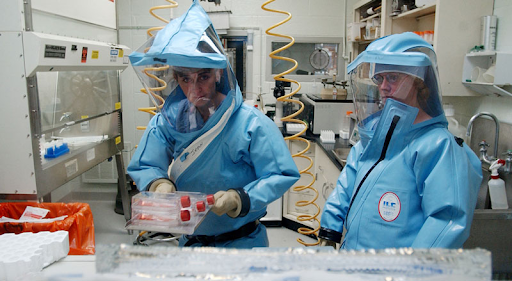
Unsterilized laboratory wastewater from a top U.S. military lab spilled into public waterways, according to reports.
The U.S. Army Medical Research Institute of Infectious Diseases at Fort Detrick, Maryland, spewed the water out the top of a rusty 50,000-gallon outdoor holding tank.
The pressure catapulted the water over the short concrete wall that was supposed to contain hazardous spills.
The tank holding waste from labs working with Ebola, anthrax, and other lethal pathogens had become overpressurized, forcing the liquid out of a vent pipe.
An estimated 2,000-3,000 gallons streamed into a grassy area a few feet from an open storm drain that dumps into Carroll Creek — a centerpiece of downtown Frederick, Maryland, a city of about 80,000 an hour’s drive from the nation’s capital.
But as the waste sprayed for as long as three hours, records show, none of the plant’s workers apparently noticed the tank had burst a pipe.
This was despite the facility being under scrutiny from federal lab regulators following catastrophic flooding and an escalating series of safety failures that had been playing out for more than a week.
Before the outdoor tank failed, there had already been breaches of other lab waste storage tanks inside the sterilization plant.
The incident happened on May 25, 2018, the Friday morning before Memorial Day weekend, and was revealed in a new book titled “Pandora’s Gamble: Lab Leaks, Pandemics, and a World at Risk.”
On May 17, 2018, in the wake of devastating storms, workers at Fort Detrick discovered that the plant’s basement was filling with water that would reach 4 to 5 feet deep.
Some of it was rainwater seeping in from outdoors.
But a lot was fluid leaking from the basement’s long-deteriorating tanks that held thousands of gallons of unsterilized lab wastewater.
As basement sump pumps forced floodwater into these tanks, the influx disgorged lab waste through cracks along the tops of the tanks, sending it streaming back toward the floor.
The steam sterilization plant, referred to as “the SSP,” was built in 1953.
It was designed to essentially cook the wastewater that flowed into it from Fort Detrick’s biological laboratories, ensuring that all deadly pathogens were killed before the water was released from the base into the Monocacy River.
The research institute’s safety protocols called for a two-step kill process for lab wastewater.
Before it was sent down drains into Fort Detrick’s dedicated laboratory sewer system for heat treatment at the plant, lab workers were supposed to pretreat potentially infectious liquids with bleach or other chemicals.
But chemical disinfection can be tricky.
To be effective, it requires workers to use the right kind of disinfectant at the right concentration and, importantly, to ensure that the disinfectant remains in contact with the microbes long enough to kill them.
Any living organisms left behind could multiply.
Despite the plant’s importance to protecting public health, by May 2018 it had become a rusting, leaking, temperamental hulk.
It was 65 years old and was supposed to have been torn down already.
But a replacement plant completed at a cost to taxpayers of more than $30 million had suffered a “catastrophic failure” in 2016 and couldn’t be repaired, records show.
So even though the sterilization plant was in significant disrepair, the institute still used it, with a much smaller amount of waste coming from a U.S. Department of Agriculture lab that worked with weeds and plant diseases.
On a typical day in 2018, state records show that these facilities sent about 30,000 gallons of laboratory wastewater into the plant, which had five 50,000-gallon storage tanks in its basement, plus an additional nine interconnected 50,000-gallon storage tanks outside.
Fort Detrick officials had been aware for some time that the tops of the aging basement storage tanks had multiple leaks caused over the years by chlorine gases accumulating on the surface of the wastewater, according to a state investigation report of the incident and the Army garrison’s responses to questions.
It was so much of an issue that the garrison’s Directorate of Public Works employees, who operated the plant, had to make sure the tanks didn’t ever fill up completely or else the potentially infectious water would spill out.
Their workaround was to try to limit the amount of waste in each basement tank to about half capacity.
But the flooding in May 2018 made that impossible because the sump pumps were sending so much water into the sterilization system.
Lab inspectors from the Centers for Disease Control and Prevention (CDC) had apparently failed to recognize the plant was in such disrepair.
The CDC offered no explanation of how the problems were missed, but after the incident, it created a new policy and task force for overseeing labs’ wastewater decontamination systems.
Samuel Edwin, director of the CDC’s select agent regulatory program, did not grant an interview.
Two years before the plant flooded and failed, the CDC had hired Edwin from USAMRIID, where he had spent eight years as the biological surety officer and responsible official in charge of making sure USAMRIID’s labs complied with federal regulations.
Edwin, in an emailed statement, said he wasn’t aware of any corrosion or leak issues while he worked at USAMRIID.
“*** photos got the base’s attention. USAMRIID’s leadership.ors from the CDC inspected the plant annually,” Edwin said
“FSAP did not observe, and I did not report, any issues with the SSP during this time.”
Four days after the plant flooded, CDC inspectors arrived at Fort Detrick and spent May 21 and 22, 2018, inspecting the facility.
As the CDC inspectors left Fort Detrick, they allowed USAMRIID to resume some research activities.
READ MORE: WHO: Biolab Containing ‘Extremely Dangerous’ Viruses Seized by Militants